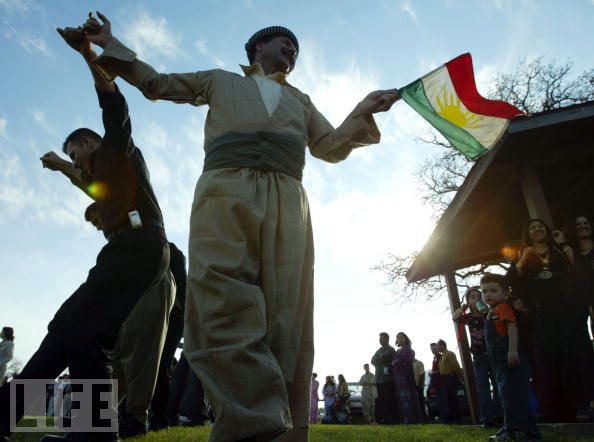
Kurdish culture
Kurdish culture has distinctive traits that are different from that of other cultures; however, Kurdish traditions are somewhat similar to those of the Iranians. Some of these similarities include the large celebrations involved with occasions like weddings. Additionally, both cultures celebrate 'Newroz', which is their New Year celebration. Newroz is celebrated on twenty first of March. Kurds are considered as moderate Muslims thus the less observation of Islamic rules. For example, Kurdish culture allows women to work outside their homes. Unlike other Muslims, Kurdish cultures have less restriction about women wearing the 'hijab' (covering). The Kurdish people also have unique wedding cultures admired by many people around the world.
kurdish clothes
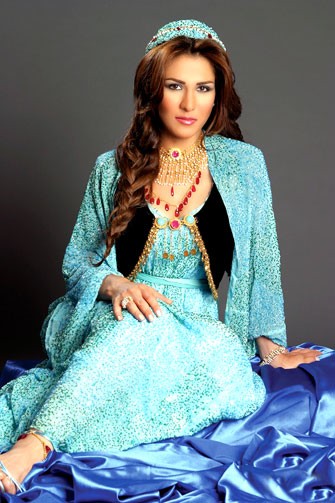


Kurdish shoes (Klash) for man
Kurdish Music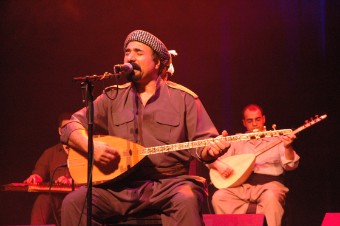
Traditionally, there are three types of Kurdish Classical performers - storytellers (çîrokbêj), minstrels (stranbêj) and bards (dengbêj). There was no specific music related to the Kurdish princely courts, and instead, music performed in night gatherings (şevbihêrk) is considered classical. Several musical forms are found in this genre. Many songs are epic in nature, such as the popular Lawiks which are heroic ballads recounting the tales of Kurdish heroes such as Saladin. Heyrans are love ballads usually expressing the melancholy of separation and unfulfilled love. Lawje is a form of religious music and Payizoks are songs performed specifically in autumn. Love songs, dance music, wedding and other celebratory songs (dîlok/narînk and bend), erotic poetry and work songs are also popular.
Musical instruments include the tembûr (tembûr, saz), biziq (bozuk), qernête (Duduk) and bilûr (Kaval) in northern and western Kurdistan, şimşal (long flute), cûzele, kemençe and def (frame drum) in the south and east. Zirne (wooden shawm) and dahol (drum) are found in all parts of Kurdistan.
The most frequently used song form has two verses with ten syllable lines. Kurdish songs (stran or goranî) are characterized by their simple melodies, with a range of only four or five notes. 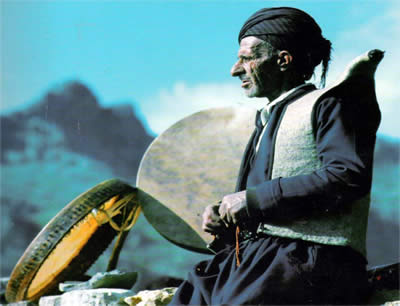
Kurdish Danc
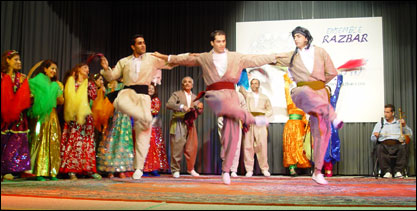
Kurdish dance (Kurdish: Govend, ههڵپهركێ / Hilperkê ) is a group of traditional hand-holding dances similar to those from the Balkans, Lebanonand East European countries. It is a form of round dancing, with a single or a couple of figure dancers often added to the geometrical centre of the dancing circle. According to the Encyclopaedia of Islam, Kurds sing and dance in all of their festivals, birthdays, circumcisions, marriage ceremonies, peasant gatherings and some religious ceremonies. Its noteworthy that these folkloric dances are mixed-gender which distinguishes the Kurds from a few other neighbouring Muslim populations.
Roots of Kurdish dance
Kurdish dances reflect samples of Kurdish life over the past thousands of years. Rhythmic and elegant movements (originating from historical record, geographical location, the Kurdish way of living, beliefs, work and struggle, war and quarrel), are called called Halparke (or Helperkê/Hilperkê in Kurdish alphabet). Halparke has got its special place in Kurd's culture in a way that knowing about that needs the deep and valid slight of the viewers to watch the dancers' singing and giving thanks in Hoshar fighting against cruelty in Zangi joy and happiness in Garyan, etc..
The dancers, hand in hand, are depositories of centuries of revealed culture in Halparke that indicates their unity in history. These movements differ in different parts of Kurdistan from the variety point of views, and joy and worry have their own special place. Some kinds of these rhythms wear out and are forgotten through the passage of time. Kurdish people from Kurdistan mainly dance the helperke, it is more easier and the simplest.